
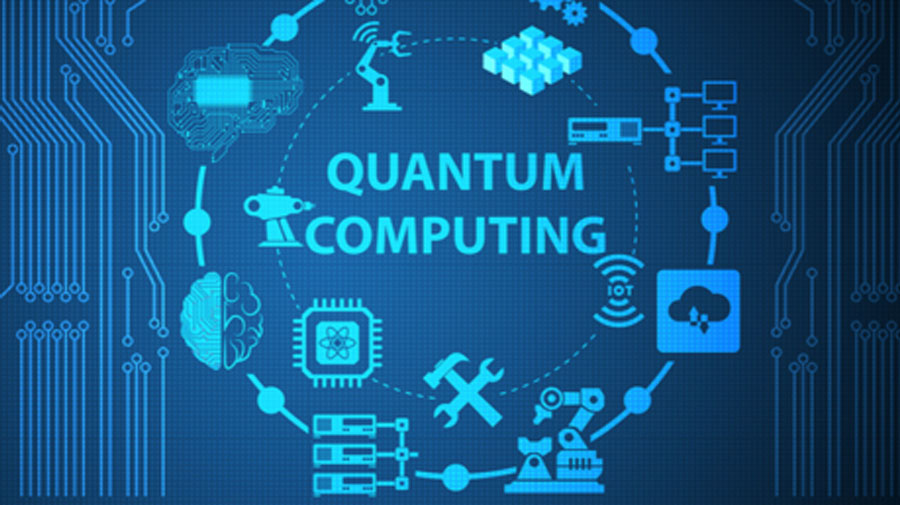
Quantum Computing Future Technology Trends
A Quantum Computer works using quantum principles. Quantum principles require a new dictionary of terms to be fully understood, terms that include superposition, entanglement, and decoherence. Let’s understand these principles below.
Superposition
Superposition states that, much like waves in classical physics, you can add two or more quantum states and the result will be another valid quantum state. Conversely, you can also represent every quantum state as a sum of two or more other distinct states. This superposition of qubits gives quantum computers their inherent parallelism, allowing them to process millions of operations simultaneously.
Entanglement
Quantum entanglement occurs when two systems link so closely that knowledge about one gives you immediate knowledge about the other, no matter how far apart they are. Quantum processors can draw conclusions about one particle by measuring another one. For example, they can determine that if one qubit spins upward, the other will always spin downward, and vice versa. Quantum entanglement allows quantum computers to solve complex problems faster.
When a quantum state is measured, the wavefunction collapses and you measure the state as either a zero or a one. In this known or deterministic state, the qubit acts as a classical bit. Entanglement is the ability of qubits to correlate their state with other qubits.

Decoherence
Decoherence is the loss of the quantum state in a qubit. Environmental factors, like radiation, can cause the quantum state of the qubits to collapse. A large engineering challenge in constructing a quantum computer is designing the various features that attempt to delay the decoherence of the state, such as building specialty structures that shield the qubits from external fields.
Quantum annealing uses a physical process to place a quantum system’s qubits in an absolute energy minimum. From there, the hardware gently alters the system’s configuration so that its energy landscape reflects the problem that needs to be solved. The advantage of quantum is that the number of qubits can be much larger than those available in a gate-based system. However, their use is limited to specific cases only.
Quantum computing is a multidisciplinary field comprising aspects of computer science, physics, and mathematics that utilizes quantum mechanics to solve complex problems faster than classical computers. The field of quantum computing includes hardware research and application development.
See our other blog click me


